

Total Solar Eclipse 2026: Everything You Need to Know Before August 12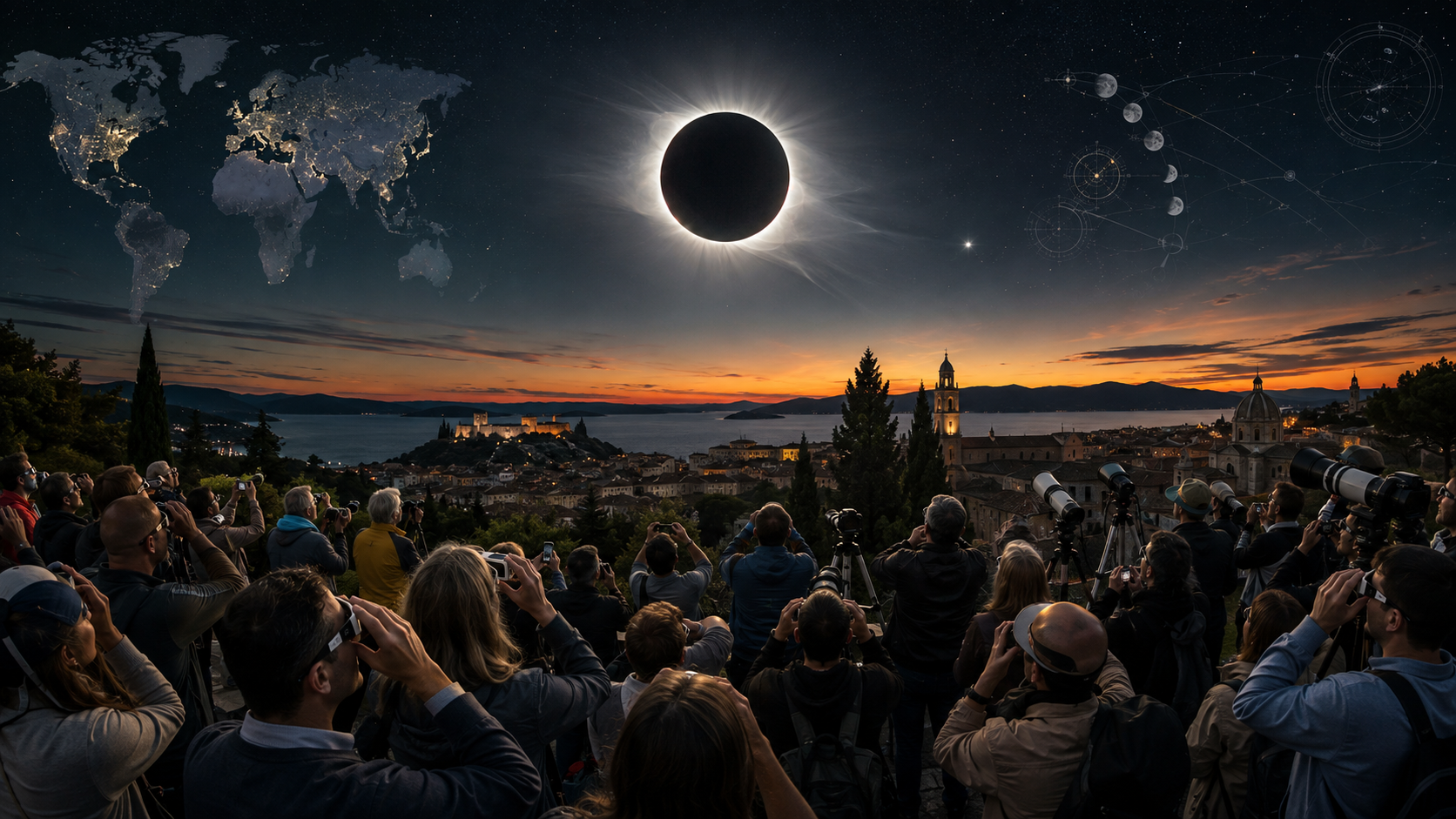 Skywatchers around the world are preparing for one of the most anticipated astronomical events of 2026: a total solar eclipse on August 12. The rare celestial event is expected to attract astronomers, photographers, travelers and curious observers as the Moon passes directly between Earth and the Sun, temporarily blocking the Sun’s bright disk for people located along the path of totality.
A total solar eclipse occurs when the Moon appears large enough in the sky to completely cover the Sun. During the brief period of totality, daylight can become noticeably darker and the Sun’s outer atmosphere, known as the corona, becomes visible around the Moon’s silhouette. The experience can last only a short time, making careful planning essential for anyone hoping to witness the event.
Where Can You See the Eclipse?
The eclipse’s path of totality will cross parts of the North Atlantic region, Greenland, Iceland, Spain and Portugal, making several locations particularly attractive to eclipse travelers.
Spain is expected to be one of the major destinations for observers because of its accessibility and extensive viewing opportunities. Iceland and Greenland also offer dramatic landscapes that could provide spectacular backdrops for photography.
However, being inside the path of totality does not guarantee a perfect view. Cloud cover and local weather conditions can determine whether observers actually see the eclipse. Travelers are therefore encouraged to monitor reliable weather forecasts as the event approaches.
Why Is a Total Eclipse So Special?
Solar eclipses are relatively uncommon at any individual location because the Moon’s shadow follows a narrow path across Earth’s surface. A total eclipse is particularly spectacular because observers inside that path can see the Sun’s corona, which is normally hidden by the Sun’s intense brightness.
The event also provides scientists with opportunities to study the solar atmosphere and observe changes around the Sun during totality. Astronomers and research organizations around the world use eclipses to conduct observations and public education programs.
Eclipse Safety Is Essential
One of the most important rules for viewing a solar eclipse is never look directly at the Sun without proper protection.
Observers should use certified solar-viewing glasses or an appropriate solar filter designed specifically for viewing the Sun. Ordinary sunglasses are not sufficient protection.
Cameras, binoculars and telescopes also require appropriate solar filters when pointed toward the Sun. Looking through an unfiltered optical device can cause serious eye injury.
During the brief period of totality, when the Sun’s bright disk is completely covered, direct viewing is possible. However, once any part of the bright solar surface becomes visible again, proper eye protection must immediately be used.
Why Travelers Are Planning Ahead
The eclipse is expected to generate significant interest among astronomy enthusiasts and travelers. Popular viewing locations may experience increased demand for hotels, transportation, tours and public viewing events.
Photography enthusiasts are also preparing equipment in advance. Capturing the corona requires careful planning because totality is brief and lighting conditions change dramatically.
For travelers, flexibility may be particularly valuable. If weather conditions look unfavorable in one location, having the ability to move to another viewing area could improve the chances of seeing the eclipse.
A Global Moment in the Sky
The August 12 total solar eclipse combines science, travel, photography and public fascination with space. Millions of people may follow the event through live broadcasts and online coverage, while those within the path of totality will have the opportunity to experience the event directly.
As the countdown continues, astronomy organizations are encouraging the public to learn about safe viewing practices and follow local guidance. Whether watched from a European landscape, observed through a live broadcast or photographed by professionals, the 2026 total solar eclipse promises to be one of the year’s most memorable astronomical events.


