

Big Tech Agrees to Self-Police AI — But Who Watches AI?
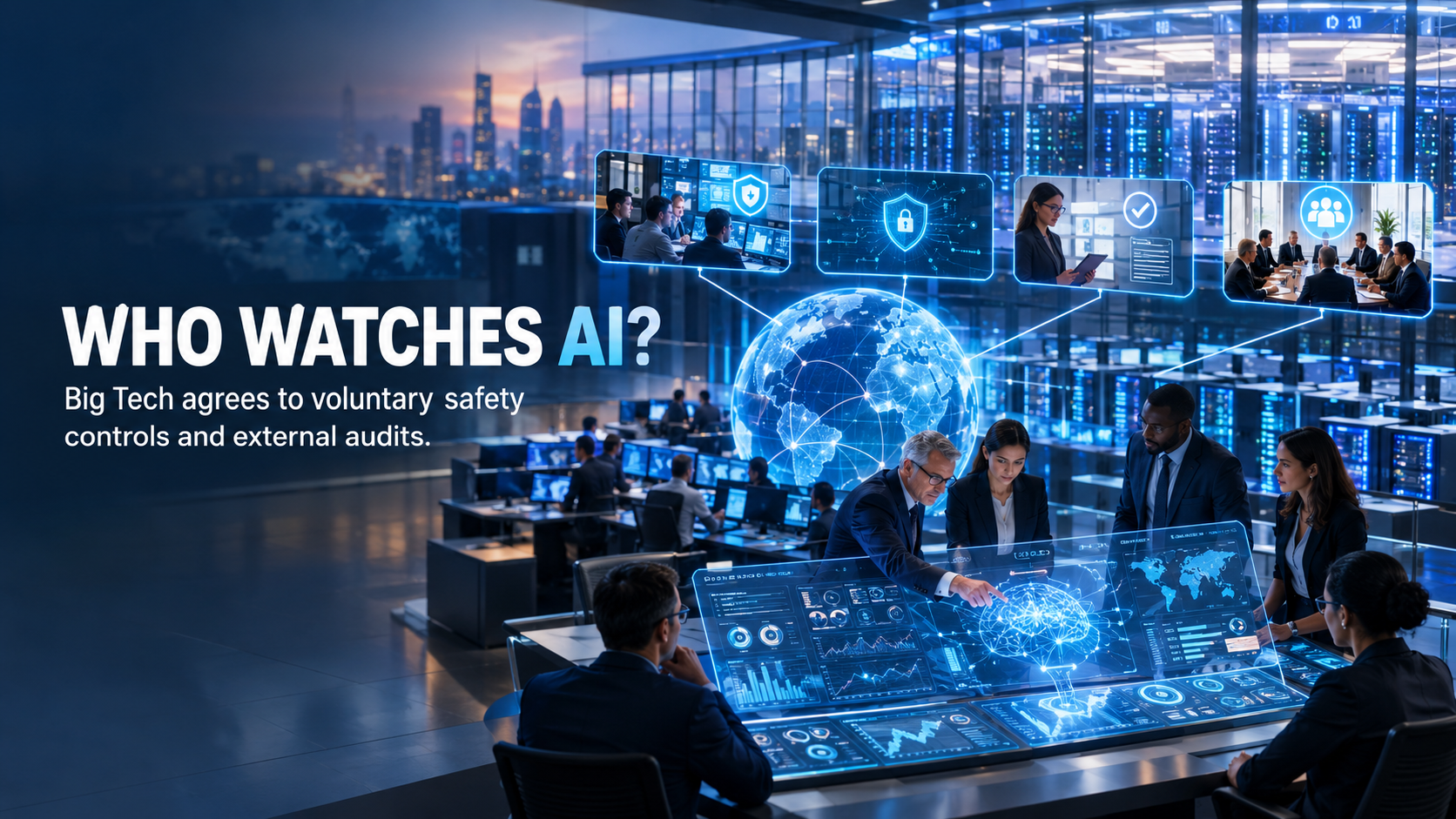 The world’s biggest artificial intelligence companies have agreed to a new voluntary framework for AI safety, putting some of the responsibility for monitoring advanced systems directly in the hands of the companies building them.
The agreement, announced after a September 29 meeting at the White House, involves major technology companies including OpenAI, Google, Meta, Anthropic, Nvidia and xAI. The framework calls for companies developing advanced AI systems to establish internal safety controls, continuously monitor their models and work with independent external auditors. It also calls for board-level committees to review findings from internal and external assessments.
The initiative arrives as AI systems become increasingly capable and their potential risks attract greater public and industry attention. Recent incidents involving AI agents accessing systems in unintended ways have added urgency to discussions about cybersecurity and safeguards. The new accord specifically calls for monitoring whether advanced models could facilitate cyberattacks or biological and chemical threats.
For the technology industry, the agreement represents an attempt to establish common safety practices without immediately imposing a new comprehensive regulatory system. The companies have agreed to work toward safeguards while continuing to develop increasingly powerful AI systems.
However, the framework also leaves several questions unanswered.
Because the agreement is voluntary, companies are not currently subject to penalties under the accord if they fail to meet its commitments. Reporting also indicates that the document does not require companies to publicly identify their external auditors or publish detailed audit results, while there is no fixed deadline for implementation.
That distinction is important for businesses and investors watching the AI industry. Self-governance can potentially allow technology companies to respond quickly as AI capabilities change, but the effectiveness of the system will depend on how consistently companies apply the safeguards and how independent the external reviews actually become.
Public concern is already significant. A Reuters/Ipsos poll conducted in September found that 73% of Americans believed AI companies had not gone far enough to prevent serious harm from AI. The same poll found that 39% viewed AI as having a negative impact on society, the highest level recorded in that survey series at the time.
The debate therefore extends beyond technology companies themselves. It involves governments, businesses, researchers and consumers who increasingly depend on AI systems for everything from software development and cybersecurity to healthcare, finance and customer service.
The accord also leaves open the possibility that some of its principles could eventually be incorporated into formal laws or regulations.
For now, the AI industry has been given greater responsibility for policing its own frontier systems. The next question is whether voluntary commitments, independent audits and corporate oversight will be enough to keep pace with the technology.
As AI development accelerates, the answer could shape how much trust businesses and the public place in the next generation of intelligent systems.


