

U.N. General Assembly: Wars, AI Governance and Global Cooperation Under Pressure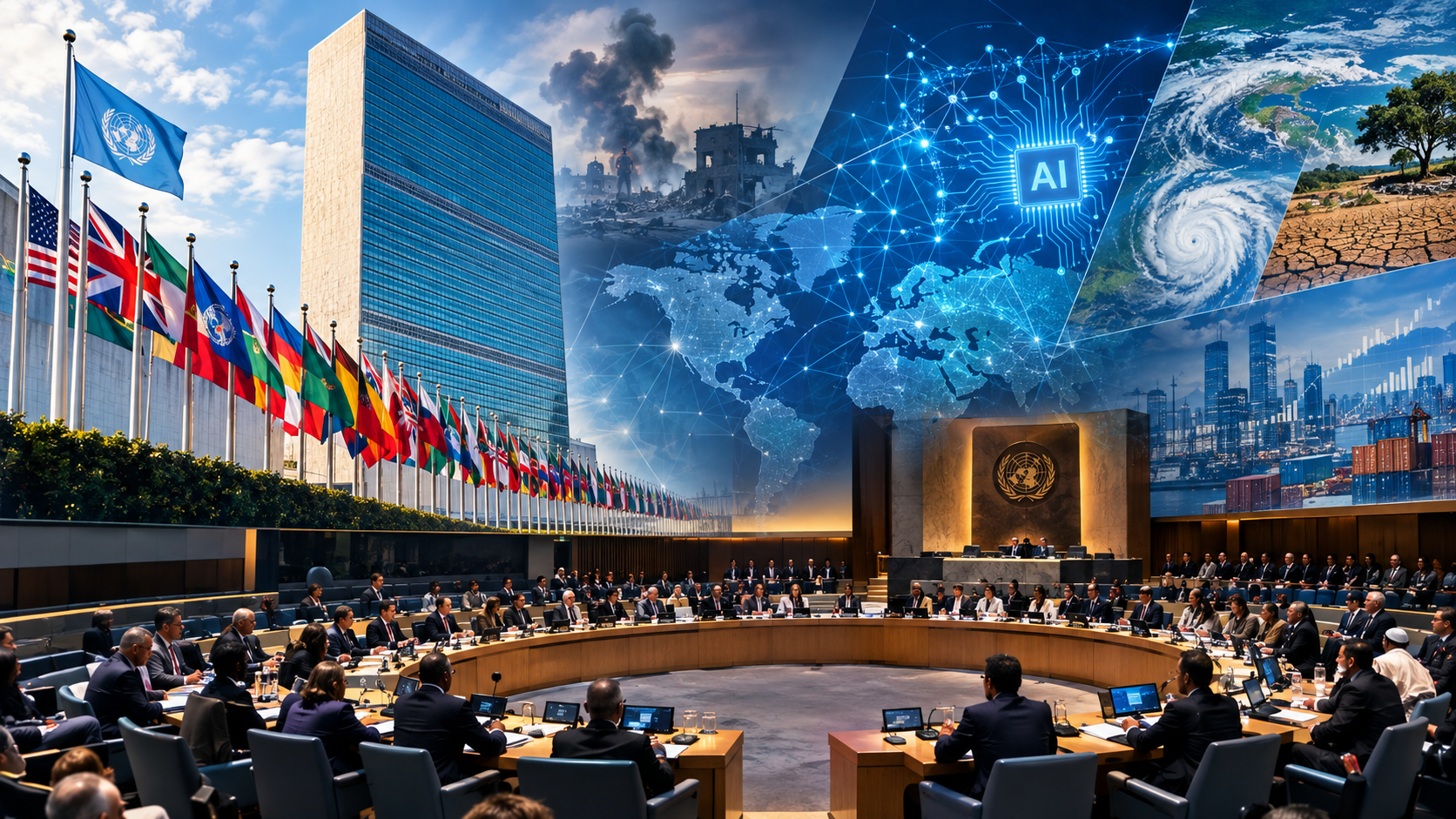 World leaders are gathering at the United Nations in New York as international diplomacy faces a series of interconnected challenges. Conflicts in the Middle East and Ukraine, growing geopolitical divisions, climate concerns and the rapid development of artificial intelligence are placing pressure on governments to find areas of cooperation.
The 81st United Nations General Assembly’s high-level week is taking place from September 18 to 28, 2026. Its agenda includes the annual general debate, discussions on climate action, sea-level rise and pandemic preparedness. The broad range of issues reflects how security, technology, health and economic stability are increasingly connected.
Wars and Geopolitical Divisions
Ongoing conflicts remain central to the international discussion. The Middle East and Ukraine are among the major issues shaping diplomatic exchanges, while disagreements between powerful countries continue to affect the ability of international institutions to build consensus.
In his final address to the General Assembly as secretary-general, António Guterres called for an end to wars, stronger action on climate change and reforms to international institutions. He also urged governments to develop stronger oversight of artificial intelligence and protect the principles of international cooperation. His second term ends on December 31, 2026.
The statements underline a central challenge for the United Nations: maintaining a platform for dialogue even when governments disagree over security, national interests and the interpretation of international law.
Artificial Intelligence Becomes a Security Issue
Artificial intelligence has moved beyond a technology-sector discussion and become a subject of international security and governance. On September 23, AI leaders briefed the U.N. Security Council about potential risks linked to increasingly powerful systems.
Anthropic chief executive Dario Amodei warned that poorly managed AI could pose risks to humanity. Technology leaders have called for governments to coordinate on safety assessments, safeguards and international standards.
However, governments do not share a single approach. Reuters reported that U.S. officials rejected calls for new global AI governance structures, reflecting the administration’s position that the United States should preserve its technological competitiveness. This difference illustrates the challenge of creating common rules while countries and companies compete to develop advanced systems.
Questions surrounding AI include cybersecurity, autonomous capabilities, misinformation, critical infrastructure and the possibility that future systems could be used in ways that create national-security risks. The debate is likely to continue as policymakers consider how to balance innovation with safeguards.
Climate and Global Economic Stability
Climate change is another major theme at the assembly. The United Nations has scheduled a high-level meeting on the threats posed by sea-level rise on September 24. Low-lying coastal areas and small island developing states face particular exposure to rising seas, infrastructure damage and displacement.
Climate-related risks also have economic consequences. Extreme weather can disrupt supply chains, damage infrastructure, affect agricultural output and increase pressure on public finances. International cooperation on adaptation, financing and early-warning systems therefore remains relevant to both governments and businesses.
The assembly’s wider discussions on climate and development demonstrate that environmental challenges are closely linked to economic resilience and public welfare.
Can Diplomacy Deliver Practical Results?
The United Nations remains a forum where governments can communicate, negotiate and present their priorities, but statements alone do not guarantee agreement or implementation. Progress depends on political commitment, funding, cooperation and the willingness of countries to manage competing interests.
The 2026 General Assembly highlights the scale of the issues facing the international community. Wars, AI risks, climate change and economic uncertainty cannot be addressed through isolated national decisions alone. Yet disagreements over security, regulation and institutional reform continue to complicate collective action.
As the high-level week proceeds, attention will focus on whether diplomatic discussions produce concrete commitments or simply reinforce existing divisions. The outcome will help shape the international conversation about the future of global cooperation.


