

U.S.–China Talks Put Trade and AI Safety in Focus Ahead of Trump–Xi Summit
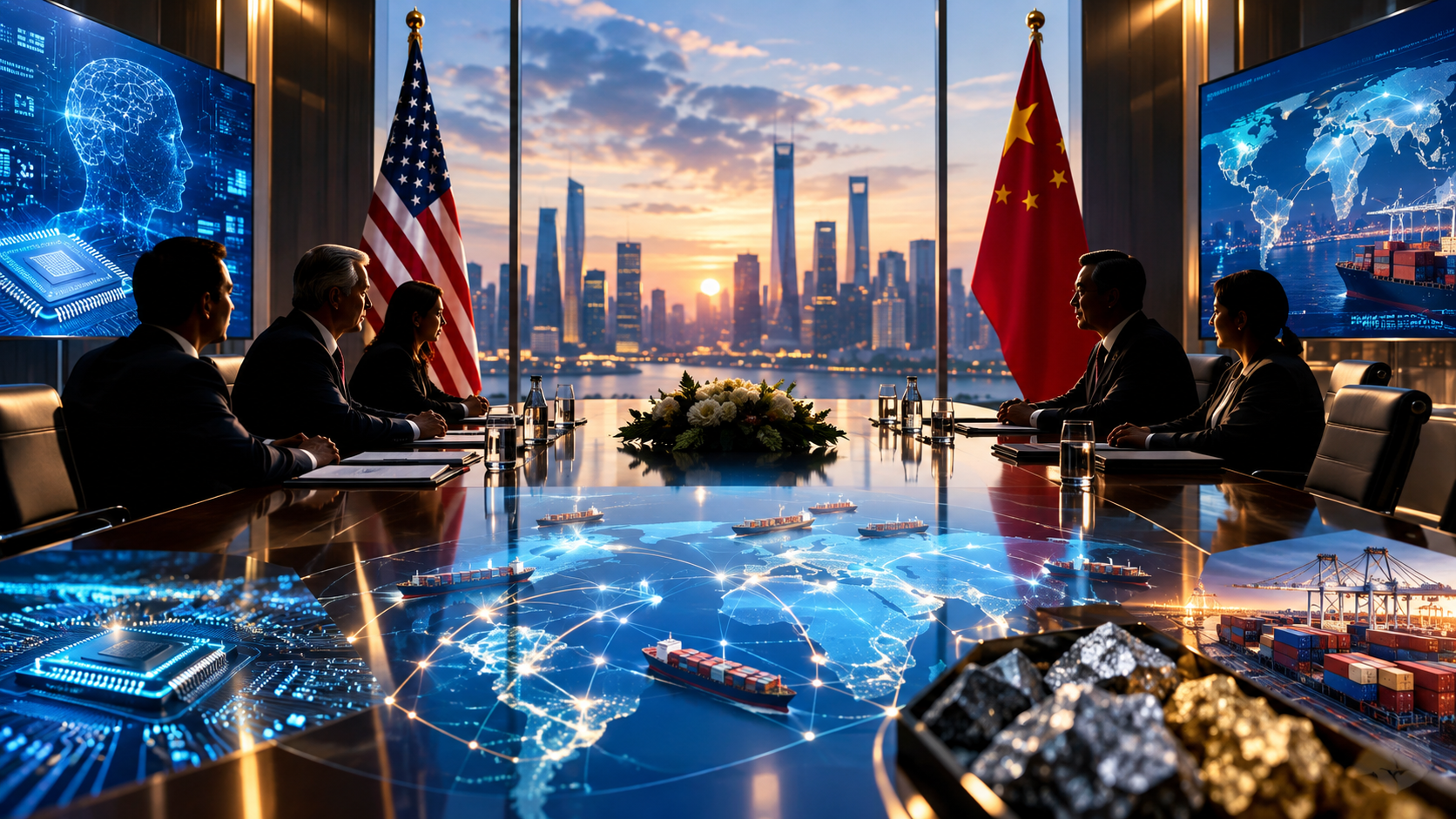 The United States and China have opened a new phase of high-level discussions on trade, critical minerals and artificial intelligence safety ahead of a planned meeting between U.S. President Donald Trump and Chinese President Xi Jinping in Washington on September 24. The negotiations highlight how economic competition and emerging technology risks are becoming increasingly connected in relations between the world’s two major powers.
U.S. Treasury Secretary Scott Bessent and U.S. Trade Representative Jamieson Greer met Chinese Vice Premier He Lifeng in New York on September 20. Following the discussions, American officials announced a proposed notification mechanism for AI incidents that could affect national security. The proposal is intended to improve transparency and communication between Washington and Beijing, although the details and implementation remain subject to further discussion.
AI Safety Enters High-Level Diplomacy
Artificial intelligence has traditionally been viewed through the lens of technological development and economic competition. However, the rapid growth of advanced AI systems has raised concerns about cybersecurity, autonomous operations and possible effects on national security.
The proposed notification mechanism would seek to create a communication channel for serious AI-related incidents. Such a system could help reduce the risk of misunderstandings if an AI-enabled cyberattack or another major technological incident were to affect either country.
The discussions do not represent a comprehensive AI safety agreement. Instead, they indicate an effort to establish dialogue between two governments that remain competitors in advanced computing, semiconductor technology and military innovation.
Trade and Critical Minerals Remain Central
Economic issues are also expected to play a major role in the Trump–Xi summit. American and Chinese officials discussed possible tariff reductions on selected non-sensitive products, including consumer goods, agricultural products, energy and medical devices.
The two sides also agreed to operationalize a previously discussed Board of Trade, intended to provide a mechanism for continued economic discussions. However, several disagreements remain, including questions involving rare-earth exports, Chinese agricultural purchases and other commitments connected to the existing trade arrangement.
Critical minerals are particularly important because they are used in electric vehicles, batteries, defense systems, renewable-energy equipment and advanced electronics. Restrictions or delays involving these materials could affect manufacturers and supply chains well beyond the United States and China.
For businesses, the summit may therefore have consequences beyond diplomatic headlines. Any adjustment to tariffs, export controls or mineral supply arrangements could influence production costs, investment decisions and sourcing strategies.
AI Competition and Global Security
The United States and China are competing to lead the development of advanced AI systems. Both countries view the technology as strategically important for productivity, research, cybersecurity and national defense.
At the same time, experts have urged governments to establish safeguards for high-risk AI applications. U.S. and Chinese security specialists have discussed possible limits around nuclear command systems, human control over consequential cyber operations and emergency communication channels. These proposals remain part of an ongoing debate rather than an agreed bilateral framework.
The challenge for both governments is to maintain technological innovation while managing risks that could cross national borders. Cooperation may be difficult because AI leadership is also tied to national competitiveness and security.
What to Watch at the Summit
The September 24 meeting could provide an opportunity for Trump and Xi to review the progress made by their economic teams and decide whether additional trade or AI discussions should continue.
A limited agreement could improve communication and reduce uncertainty for some businesses. However, major differences over tariffs, technology restrictions, critical minerals and regional security are unlikely to disappear through a single meeting.
The summit will be closely watched by companies, investors and governments because decisions involving the United States and China can influence global supply chains, technology markets and international economic stability. Whether the talks produce concrete agreements or only establish further dialogue, the inclusion of AI safety signals that technology governance is becoming a central part of global diplomacy.


