

Humanoid Robots Enter the Fight Ring: Shanghai Shows What the Future of AI Can Do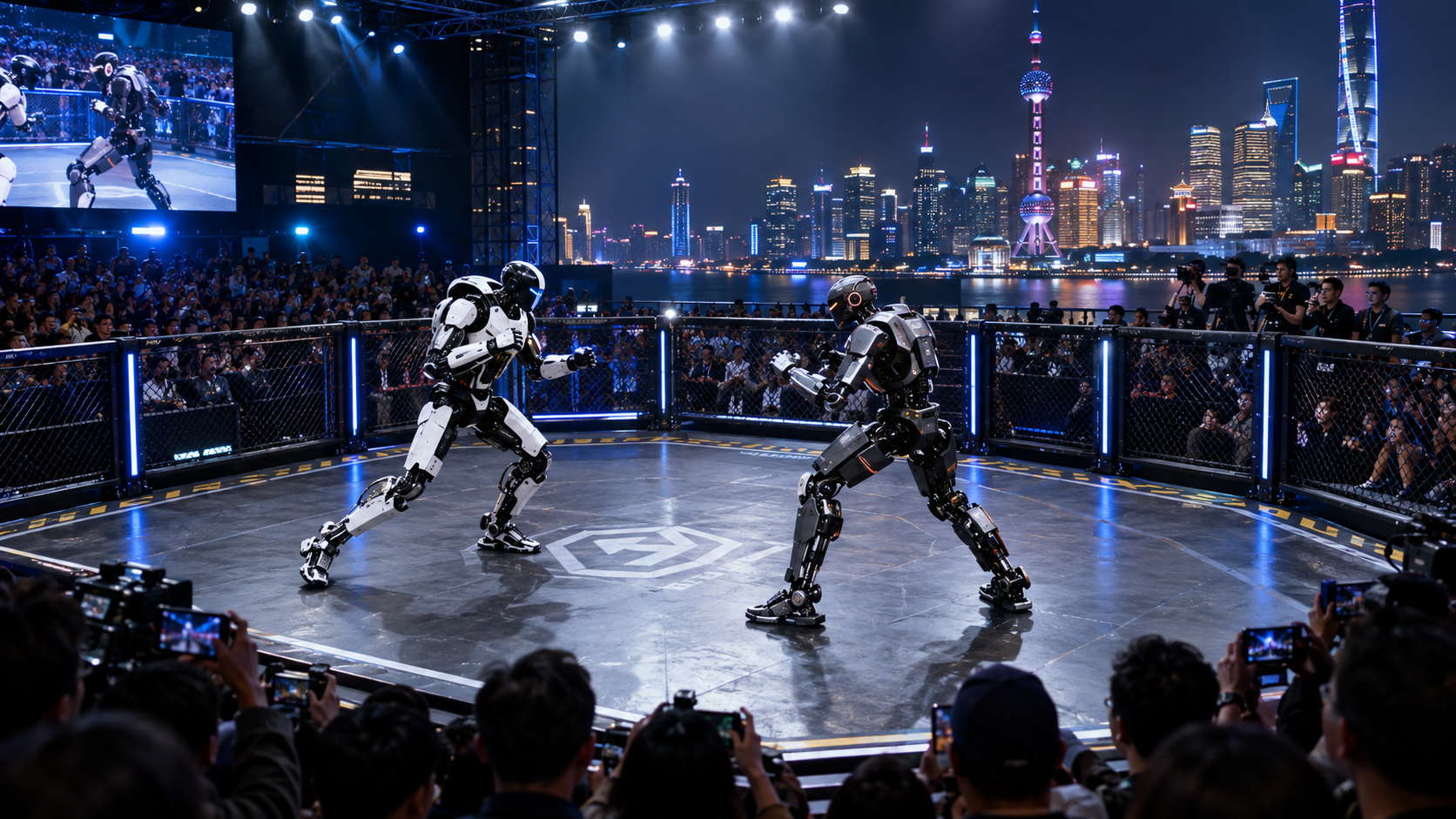 SHANGHAI — The future of artificial intelligence just stepped into a boxing ring.
Humanoid robots recently went head-to-head in Shanghai as part of the Ultimate Robot Knock-out Legend (URKL) city tour, turning a technology demonstration into something that looked remarkably like a new kind of sporting event. The machines moved around the ring, analyzed their opponents and selected responses in real time, offering a striking demonstration of how far embodied artificial intelligence is advancing.
The event is more than an unusual spectacle. It highlights a fundamental challenge in modern robotics: teaching machines not simply to process information, but to perceive a physical environment, make decisions and react while their surroundings are constantly changing.
From AI Screens to Physical Machines
For years, much of the public conversation around artificial intelligence has focused on chatbots, image generators and software capable of producing text, code and other digital content.
Humanoid robotics represents a different frontier.
Instead of operating entirely inside a computer, embodied AI has to interact with the physical world. A robot must maintain balance, understand where objects and people are located, coordinate multiple joints and respond quickly when something unexpected happens.
A fight ring is an unusually demanding environment for that technology.
During the Shanghai event, the humanoid machines autonomously navigated the ring, read their opponents’ movements and selected responses in real time. In one match, a T800 robot reportedly continued fighting after suffering serious damage to its head and neck.
EngineAI’s T800 Takes Center Stage
The competition is associated with EngineAI, a Shenzhen-based robotics company developing general-purpose humanoid machines. Its T800 is a full-size humanoid platform measuring 173 centimeters, with the company listing 29 degrees of freedom excluding its dexterous hand and maximum joint torque of up to 450 N·m. EngineAI also presents the T800 as a general-purpose robot with potential applications including logistics, hospitality and factory collaboration.
That distinction matters.
The machines are not being developed simply to become better fighters. Combat-style demonstrations provide an extremely demanding environment in which developers can test balance, movement, perception, recovery and rapid responses.
A New Kind of Robotics Spectacle
URKL was launched by EngineAI as a humanoid robot combat competition combining robotics technology with sports and entertainment. The company’s stated objective is to create a professional platform for robotic technology innovation and competition.
The spectacle could also help bring robotics to audiences that might never watch a traditional technology demonstration.
A robot performing a controlled factory task can be impressive. Two humanoid machines moving, reacting and recovering inside a ring is instantly understandable—and highly shareable.
That makes robot combat an unusual bridge between technology and entertainment.
What Comes Next?
The bigger question is not whether robots can throw a punch.
It is whether the same perception, balance and decision-making capabilities can eventually be transferred into useful real-world environments.
Factories, warehouses, hotels, logistics centers and other workplaces are already being explored as potential applications for humanoid robotics. EngineAI itself lists several of these areas for the T800.
The International Federation of Robotics reported that approximately 7,000 humanoid robots were sold globally in 2025 for industrial and professional service applications, while noting that the sector remains at an early stage.
Shanghai’s robot fight therefore represents something larger than a viral spectacle.
It is another glimpse into a future where artificial intelligence does not simply answer questions on a screen—it moves, observes, reacts and operates in the physical world.
And that future may be arriving faster than many expected.

